Mural Collection · Of This World
Lady Gongsun
Gōngsūn Dàniáng · Lady Gongsun
Basis · Directly based on source material
Theme · Figures of History
What the picture shows
Lady Gongsun’s sword dance carried the spirit of the High Tang, and her swift, sweeping movements passed through Du Fu’s memory to bear witness to an age’s rise and fall.
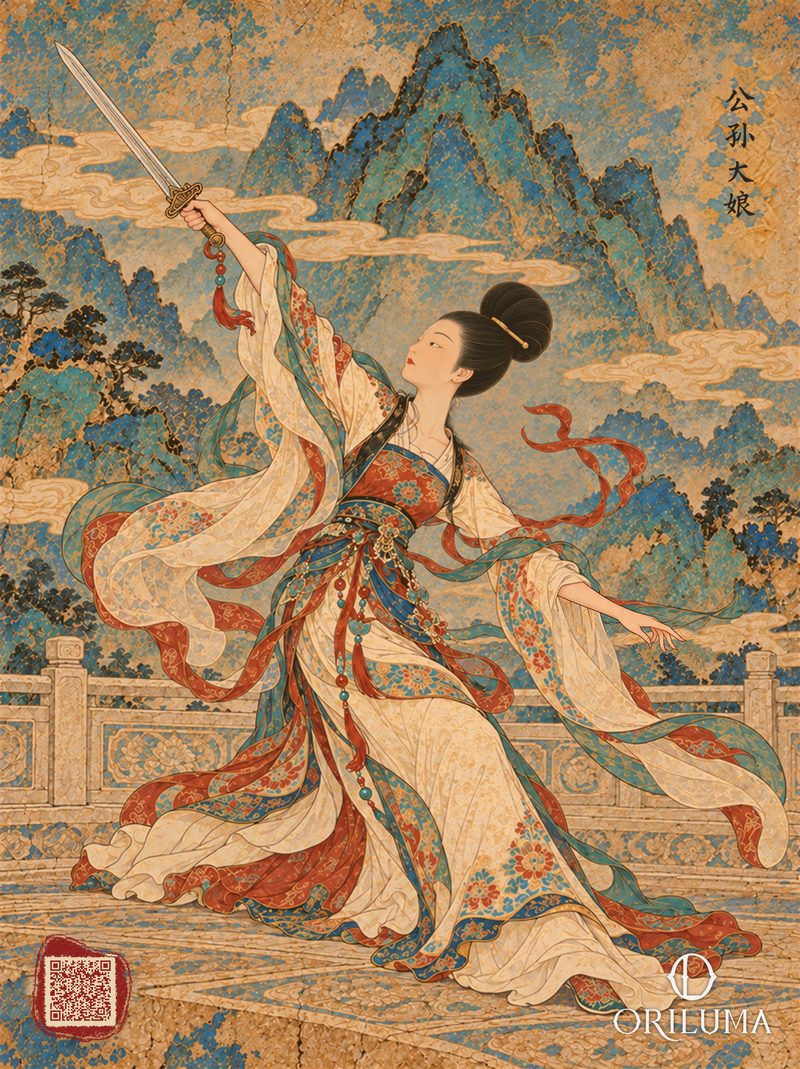
In the picture Lady Gongsun bends slightly, her weight sunk low. One hand raises a long sword high, its tip pointing to the upper left, and her eyes follow it; the other arm stretches out straight behind her, so that the two arms form one long diagonal. The movement is caught between “rising” and “falling”.
Long red and blue-green streamers wind around her arms and waist, and her skirts open layer upon layer, like wind stirred up by her steps. Beneath her feet is a brocade carpet, behind her a stretch of white marble balustrade, and farther back blue-green mountains. Stage and landscape share one picture, so the sword dance seems both a court performance and something unfolding between heaven and earth.
Look closely and you see that the sword is only the starting point: what is really painted is the path of the sashes spreading out with the sword’s momentum. The viewer sees not a single sword movement but the trace left in the air by a whole sequence of movements.
The story
Lady Gongsun
Lady Gongsun was a famous dancer of the Tang dynasty, known for dances such as the Jianqi Huntuo. When she performed the sword dance, her movements would plunge suddenly, then leap and whirl, with both vigorous strength and a woman’s grace.
As a young child Du Fu watched her perform at Yancheng. Decades later he still remembered the crowds packed like mountains, everyone moved, and heaven and earth seeming to rise and fall with her dance. The flash of the sword on that stage became one of his most vivid memories of the splendour of the Kaiyuan era.
In the Dali era Du Fu saw Lady Gongsun’s disciple Li Shi’erniang perform the sword dance. The familiar movements suddenly brought back the past, and made the poet realise that the figures of the golden age had faded away and that he himself had lived through great turmoil and displacement.
The sword in the picture is not a weapon of combat but an extension of the dance. The sword tip marks the direction of the movement, while the long sleeves and hems record the path of the turn, so that a single instant holds both the move before and the move after.
History and context
Origins and culture
Du Fu’s “Song on Watching a Disciple of Lady Gongsun Perform the Sword Dance, with Preface” is an important text for knowing this figure. Its descriptions carry artistic exaggeration, yet it preserves the reputation Lady Gongsun had in her own time as a dancer of the very first rank.
According to legend, the cursive-script calligrapher Zhang Xu, after watching Lady Gongsun’s sword dance, drew inspiration for his calligraphy from the rhythm of her movements. Although the historical details are hard to verify fully, the story vividly expresses the speed and force shared by dance, swordplay and calligraphy.
The exact form and manner of performance of the “jianqi” has long been studied and discussed, and it cannot simply be equated with modern swordsmanship. It belonged to the world of Tang music and dance, and in later poetry and painting it gradually became Lady Gongsun’s personal emblem.
The work paints not only a dancer but also how art preserves an age. The rise and fall of the dynasty lie far in the past, yet the sword’s momentum keeps unfolding through poetry and images, so that later generations can still feel the shock of that one dance.
In the preface to his “Song on Watching a Disciple of Lady Gongsun Perform the Sword Dance”, Du Fu says that in the third year of Kaiyuan (715), when he was still a child, he saw Lady Gongsun dance the Jianqi Huntuo at Yancheng, “flowing and crisp, surging and checking, unrivalled in her day”; in the second year of the Dali era, at Kuizhou, he saw her disciple Li Shi’erniang dance the sword dance, and only then wrote this poem. The two viewings were more than fifty years apart.
Du Fu’s preface also says that Zhang Xu of Wu, a master of cursive script, watched Lady Gongsun dance the Xihe Jianqi several times in Ye county, and his cursive script improved from then on. The short biography of Zhang Xu appended to Li Bai’s biography in the Xin Tang Shu also records him saying that he “watched the performer Gongsun dance the Jianqi and grasped its spirit”. Whether or not the story is exact in its details, it shows that in the eyes of Tang people dance, swordplay and calligraphy shared one rhythm: first gather force, then burst out, and finally draw back.
The poem also contains a sigh: the golden age of the past and its dancer are both long gone, and only an echo remains in the disciple. Lady Gongsun thus became a very particular figure, both a dancer and a gateway into the memory of an age.
Further reading
Sources and references
- “Song on Watching a Disciple of Lady Gongsun Perform the Sword Dance, with Preface” (Guan Gongsun Daniang Dizi Wu Jianqi Xing bing Xu)Du Fu · Tang
- Xin Tang Shu (New Book of Tang), “Biographies of Literary Figures” (middle part): the account of Zhang XuSong
More in this set