
Mural Collection · Of This World
The Fan Dance
Shànzi Wǔ · The Fan Dance
Basis · Cultural background
Theme · Dance and Music
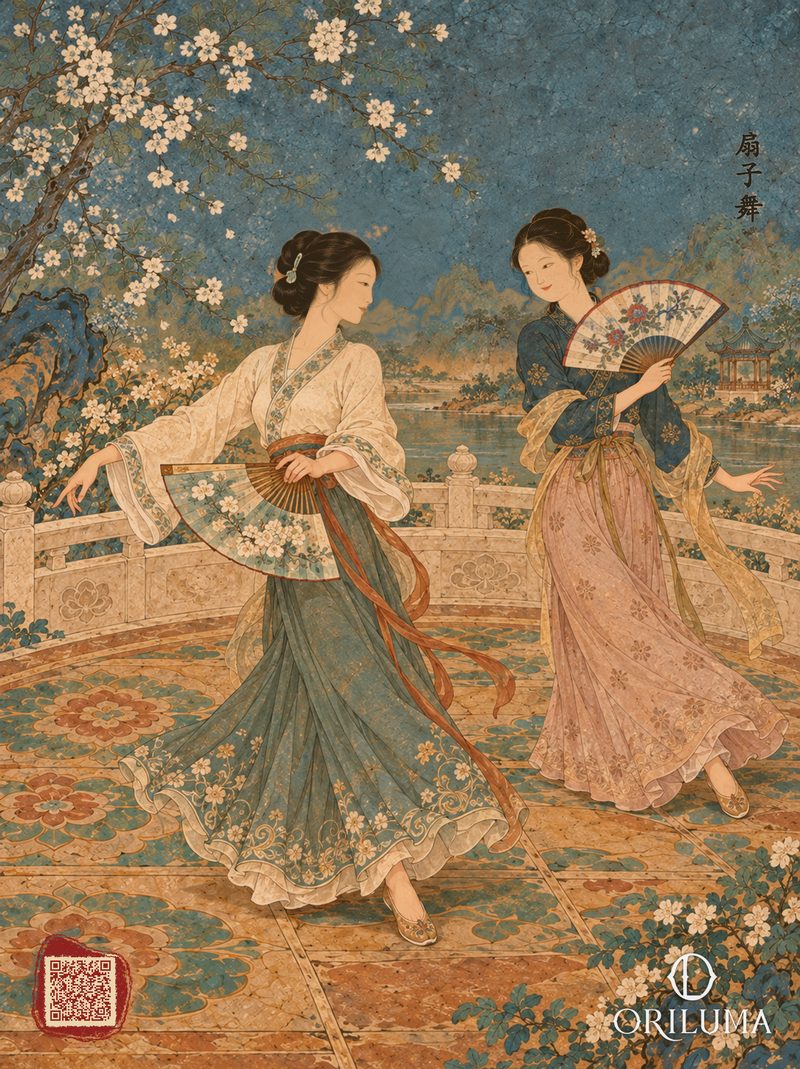
What the picture shows
As the fans open, close, turn and screen, they extend the dancers’ gestures into wind and give a still picture a continuous rhythm.
Two dancers move together in the picture. The one on the left wears an off-white top and a long grey-green skirt; she holds an open folding fan painted with white flowers crosswise at her waist, stretches her other arm outward and looks back at her companion. The one on the right wears a dark blue top and a long pink skirt; she raises a folding fan painted with red flowers beside her shoulder and tilts her head slightly, smiling.
They stand on a round platform, with white marble balustrades behind them and a finely patterned floor beneath their feet. Beyond the balustrade lie open water, distant hills and a small pavilion; a tree of white blossoms leans in from the upper left. The two women’s skirts and sashes swirl in opposite directions, showing that they are turning around each other.
Blue-grey and pink answer each other across the picture, and the golden-yellow ground ties them together. The eye slides down along fans, arms and sashes, as if reading a short passage of a dance that has not yet ended.
The story
The Fan Dance
The fan dance is a type of dance in which the fan is the main prop; there is no single story behind it. By opening and closing the fan, turning the wrist, circling it around the body, tossing and catching it, dancers turn an everyday object into a flower, a bird, a wave or a passing breeze.
Closed, a fan looks like a short stick; opened, it becomes a broad surface. This sudden change of shape lets the dancer mark clear beats between gathering and releasing, hiding and revealing.
When a dancer half covers her face, the fan draws the viewer’s attention to her eyes; when she spreads her arms, the fan extends the outline of her body. The prop both conceals and helps to express, and is closer to a second, changeable hand than to mere decoration.
In group dances, fans of different colours can form flower patterns, waves and continuous designs. A picture of a single figure often chooses the moment when the fan’s movement is fullest, so that the viewer imagines what came before and after from the direction of the sleeves and the fan ribs.
History and context
Origins and culture
Fan dances are found widely in the dances, opera and folk festivals of the Han Chinese and of many ethnic minorities. They use folding fans, round fans or fans with long silk streamers, in very different styles, and cannot be reduced to one fixed ancient routine.
The fan itself served for cooling, for etiquette, as a surface for poems and paintings, and for stage performance. Brought into dance, it carries these cultural meanings into the body, and lets the play of line and surface found in calligraphy and painting move through space.
Characters in traditional Chinese opera often use the fan to show their status and feelings: a light wave can mean ease, a sudden snap shut alarm or anger, a fan held before the face shyness. The fan dance links these small gestures together and develops them into a whole dance that speaks through the fan.
The work has no sound, yet the angle of the fans seems to record a single beat of music. By following the fan ribs, wrists and sashes, the viewer can complete, within the stillness, a dance that has not yet ended.
Both fans in the picture are folding fans. For a long time the fans of ancient China were mainly round fans. The folding fan is already recorded in the Song dynasty: in You Huan Ji Wen, Zhang Shinan mentions folding fans among the tribute goods sent from Goryeo in the sixth year of the Xuanhe era, while in Wanli Ye Huo Bian the Ming writer Shen Defu says that it only appeared when foreign states presented it as tribute in the Yongle era. Whichever account one follows, the folding fan came into wide use only in the Ming dynasty, when Suzhou, Hangzhou and Sichuan became the main centres of production; folding fans were often inscribed with poems or painted and given as gifts.
A fan in dance is often about “half hidden, half revealed”: the fan covers the face and the eyes look out from its edge, a very understated form of expression in traditional Chinese aesthetics. This is also why the fan dance invites viewers to complete it in their own imagination.
The origins of the fan dance are not settled. Some trace it to court processions and the culture of the round fan; others think it comes more from folk festivals and the shenduan of opera (shenduan is a theatre term for the movements and postures of an actor on stage). Most of these accounts are only clues, not a proven origin.
Further reading
Sources and references
- The fan dance in traditional Chinese dance and opera (folk and stage traditions)
- You Huan Ji Wen (Notes from an Official’s Travels)Zhang Shinan · Song
- Wanli Ye Huo Bian (Unofficial Gleanings of the Wanli Era)Shen Defu · Ming
More in this set