
Mural Collection · Of This World
Reaching for the Lotus
Tàn Lián Tú · Reaching for the Lotus
Basis · Cultural background
Theme · Everyday Life
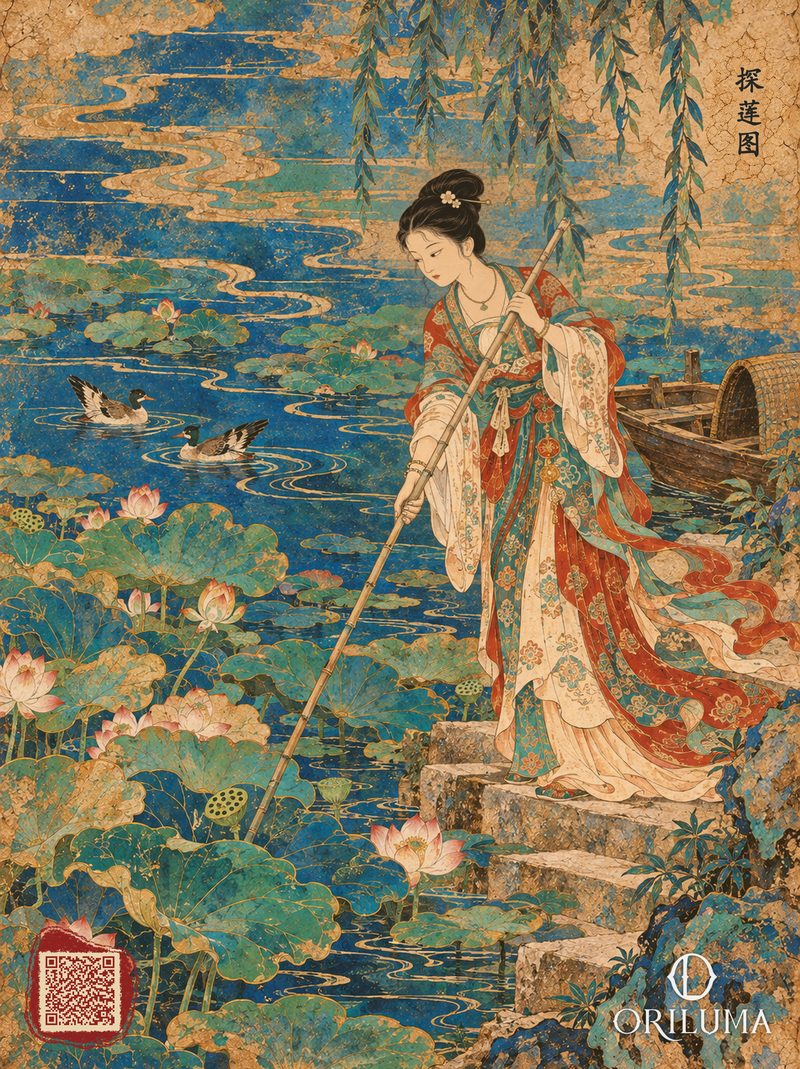
What the picture shows
A figure leans out over a lotus pond to look for a new lotus deep among the flowers and leaves, filling the picture with summer haze over the water and with curiosity.
On the right of the picture a woman stands on stone steps at the lake’s edge, holding a long bamboo pole. Its tip reaches deep among the lotus leaves, as if parting them, or testing how deep the water is.
The pond is full of round lotus leaves and pink and white lotus flowers, with seed pods standing upright among the blossoms. Two wild ducks swim leisurely across the water, and a small boat with a woven bamboo canopy is moored at the bank. Willow branches hang down from the top of the picture and fall beside her.
The water is so blue it almost glows, and the green of the leaves deepens layer by layer. Her clothes are mainly red and blue-green, the warmest colours in the whole painting, and catch the eye at once.
The story
Reaching for the Lotus
“Reaching for the Lotus” can be read as an everyday subject of seeking, viewing or gathering lotus, and has no single fixed story. The figure stands on stone steps by the water and parts the leaves with a long pole, reaching toward something newly stirring among the flowers and leaves.
A lotus pond is not orderly: tall leaves hide low flowers, and reflections on the water conceal the stems. The single word tan in the Chinese title, “to reach” or “to probe”, tells us that looking here means coming close, and gives the figure’s movement a touch of care and curiosity.
She may be looking for a bud about to open, or gathering seed pods, or picking a flower to give to someone. The work leaves the outcome outside the frame; the viewer can only follow the tip of the pole and her gaze further into the depths of the leaves.
At the water’s edge one’s balance is unsteady, and sashes and long skirts easily get wet, so the figure’s slight forward lean is both graceful and true to life. The quiet pond is woken by this movement, as if in the next moment a fish might leap or a dewdrop fall into the water.
History and context
Origins and culture
The theme of gathering lotus was handed down for centuries, from the Han yuefu songs to the poetry of the Southern Dynasties, and often described young men and women working on the water, singing to each other and drawn to one another. Later painting developed it into pictures of ladies in summer and of life in the water country.
The lotus carries symbols of purity, good fortune and Buddhism all at once, and the many seeds of the pod often stand for the continuation of life. Yet a particular work can first of all be seen as an encounter between people and nature; there is no need to read every leaf as a fixed symbol.
Compared with “The Lotus Dance”, reaching for the lotus places more weight on action within a setting: the dancer turns herself into a flower, while the lotus-seeker remains herself, searching for and touching the plants on a real shore.
The work slows summer time down. She has not yet picked anything, and the lotus has not yet fully appeared; what means most is the moment just before discovery, when the gaze has already arrived and the hand is still on its way.
“Jiangnan” (South of the River) is a well-known lotus-gathering poem among the Han yuefu. It opens with “South of the River the lotus can be gathered; how lush the lotus leaves!”, and its closing lines repeat how the fish swim east, west, south and north among the lotus leaves, so that it reads like a light, quick little tune. From then on, gathering lotus became a lasting theme in Chinese poetry.
In Chinese, the he of hehua (lotus flower) sounds like the words for “harmony” and “union”, and the many seeds in the pod stand for many children and much good fortune; in Buddhism, the lotus rises from the mud unstained and symbolises purity. A single lotus pond can hold so many layers of meaning at once, which is why it is so well suited to painting.
Views of what the lotus symbolises also differ. Buddhism takes it for purity; Zhou Dunyi, in “On Loving the Lotus”, compares it to the junzi, the person of noble character; popular tradition favours the auspicious wish “lian sheng gui zi”, for fine sons born one after another, in which lian also sounds like “lotus”. As for the Han yuefu “Jiangnan”, some read it as a work song sung while gathering lotus, while some scholars find in it the flavour of a love song about young men and women at play.
Further reading
Sources and references
- “Jiangnan” (South of the River)Han yuefu
- “Ai Lian Shuo” (On Loving the Lotus)Zhou Dunyi · Northern Song
More in this set