Mural Collection · Of This World
Zhaojun Crosses the Frontier
Zhāojūn Chū Sài · Zhaojun Crosses the Frontier
Basis · Directly based on source material
Theme · Figures of History
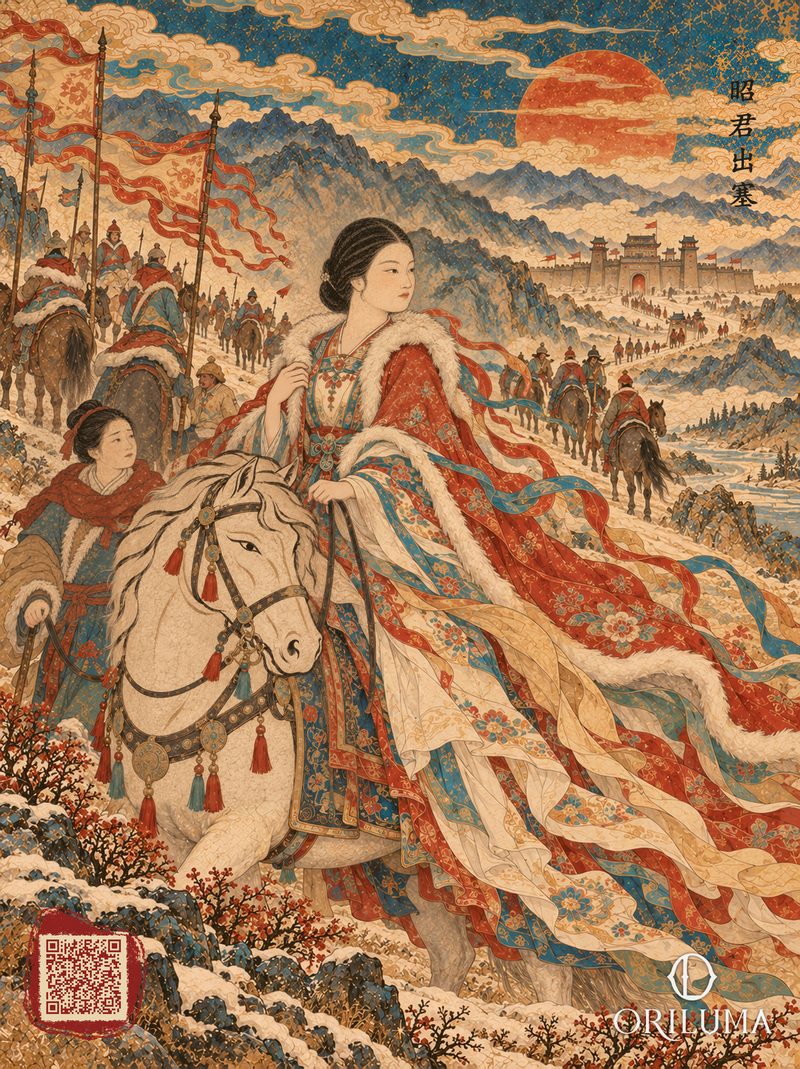
What the picture shows
Wang Zhaojun leaves Chang’an for the lands beyond the frontier, and a political marriage becomes, in history and literature, a complex image of peace, homesickness and choice.
Zhaojun rides a white horse, wrapped in a red cloak trimmed with white fur. One hand draws the collar close, the other holds the reins; her head turns slightly towards the right of the picture, and her gaze is quiet. A maid in a red headscarf walks beside the horse, leading it by the reins.
The procession stretches back along the mountain road: mounted attendants, banners raised high, and farther off rolling mountains and a frontier pass, with a red sun resting on the horizon. On the slope in the foreground the snow has not yet melted, and red shrubs show through it; the distant sky is still blue-green, with only a touch of gold at the edges of the clouds, in contrast to the vivid colours of the figures’ clothes.
The brightest things in the picture are the white horse and the red cloak, and they put her at the centre of the procession. She only draws her collar tighter and looks ahead; the whole parting lies in this quiet.
The story
Zhaojun Crosses the Frontier
In the first year of the Jingning era of the Western Han, the Xiongnu chanyu Huhanye came to court and asked for a marriage alliance. The Hanshu (Book of Han) says only that Emperor Yuan gave Wang Zhaojun, a girl of good family in the rear palace, to the chanyu; the Hou Hanshu (Book of the Later Han) says instead that after several years in the palace without ever being summoned by the emperor, she had grown sorrowful and resentful, and of her own accord asked the official in charge of the palace women to let her go. She left the Han palace for the lands beyond the frontier and became Huhanye’s consort, with the title Ninghu Yanzhi (roughly, “the consort who brings peace to the Hu”).
The procession passes the frontier gates, and wind and sand take the place of palace walls. Later works often show Zhaojun holding a pipa and looking back towards her homeland, gathering the reluctance, the unknown and the duty of the long road into a single pose.
The two histories do not agree about the children she had among the Xiongnu. The Hanshu says she bore Huhanye a son, Yituzhiyashi, and after remarrying, to Chanyu Fuzhulei, had two daughters; the Hou Hanshu says she bore two sons. The Hou Hanshu also says that after Huhanye died she wrote to the throne asking to return, but Emperor Cheng ordered her to follow the customs of the Hu, and so she married the succeeding chanyu. Her marriage was bound up with relations between the Han and the Xiongnu, and her personal fate was thus set within a political order far larger than herself.
The “crossing of the frontier” in the picture is not the settled life after arrival but the act of crossing a border. She rides a white horse in a red cloak, a maid leads the horse forward, and behind her are banners and a long procession; the figure is leaving a familiar world and, at the same time, walking of her own will into a new life.
History and context
Origins and culture
The Hanshu and the Hou Hanshu preserve the basic facts of Zhaojun’s journey beyond the frontier. Familiar details such as the court painter who demanded a bribe and deliberately made her portrait ugly, or “Zhaojun’s Lament”, were mostly added and embellished over time in later notes, poems and plays.
Works such as the Yuan dynasty zaju play Hangong Qiu (Autumn in the Han Palace) made her a tragic figure of steadfast loyalty, and popular tradition calls her the beauty who “made the wild geese fall”. The literary figure is not quite the same as the historical person, but it reflects how different ages imagined the frontier, women and the dynasties of the Central Plains.
“Marriage alliances brought lasting peace” is also a later idealisation. Relations between the Han and the Xiongnu still went through complex changes, but Zhaojun’s crossing of the frontier did become an important cultural memory of contact between peoples.
Looking at this subject today, we can see both the hope for peace and the personal cost. She is not simply a symbol that was sent away, but a woman who, within narrow limits, carried her burden, adapted, and left a lasting mark.
Zhaojun crossed the frontier in 33 BC, the first year of the Jingning era under Emperor Yuan of Han. Chanyu Huhanye came to the Han court and asked for a marriage alliance, and Emperor Yuan gave Wang Zhaojun to him. Zhaojun went on to live among the Xiongnu for many years, and the children she had with the chanyu later played a part in Han–Xiongnu relations too.
The pipa did not yet have its present form in the Han dynasty. That later poems and paintings link the pipa with Zhaojun probably goes back to the preface of the Western Jin poet Shi Chong’s “Song of Wang Mingjun” (Mingjun being another name for Zhaojun), which says: “In the past, when a princess was married to the Wusun, a pipa was played on horseback to console her longing on the road.” Later people transferred this image of “playing the pipa on horseback” to Zhaojun.
In the southern outskirts of Hohhot, in Inner Mongolia, there is a tomb of Zhaojun that local people call Qingzhong, the “Green Mound”. It is said that in autumn, when the grass withers, the grass on this mound alone stays green, hence the name. It is a folk act of remembrance, and it also shows that Zhaojun is cherished in the memory of the north.
Further reading
Sources and references
- Hanshu (Book of Han): “Annals of Emperor Yuan”, “Account of the Xiongnu”Eastern Han
- Hou Hanshu (Book of the Later Han): “Account of the Southern Xiongnu”Liu Song, Southern Dynasties
- Preface to “Song of Wang Mingjun”Shi Chong · Western Jin
More in this set