
Mural Collection · Myths & Legends
The Butterfly Lovers
Liáng Shānbó Zhù Yīngtái · The Butterfly Lovers
Basis · Directly based on source material
Theme · Bonds of Love
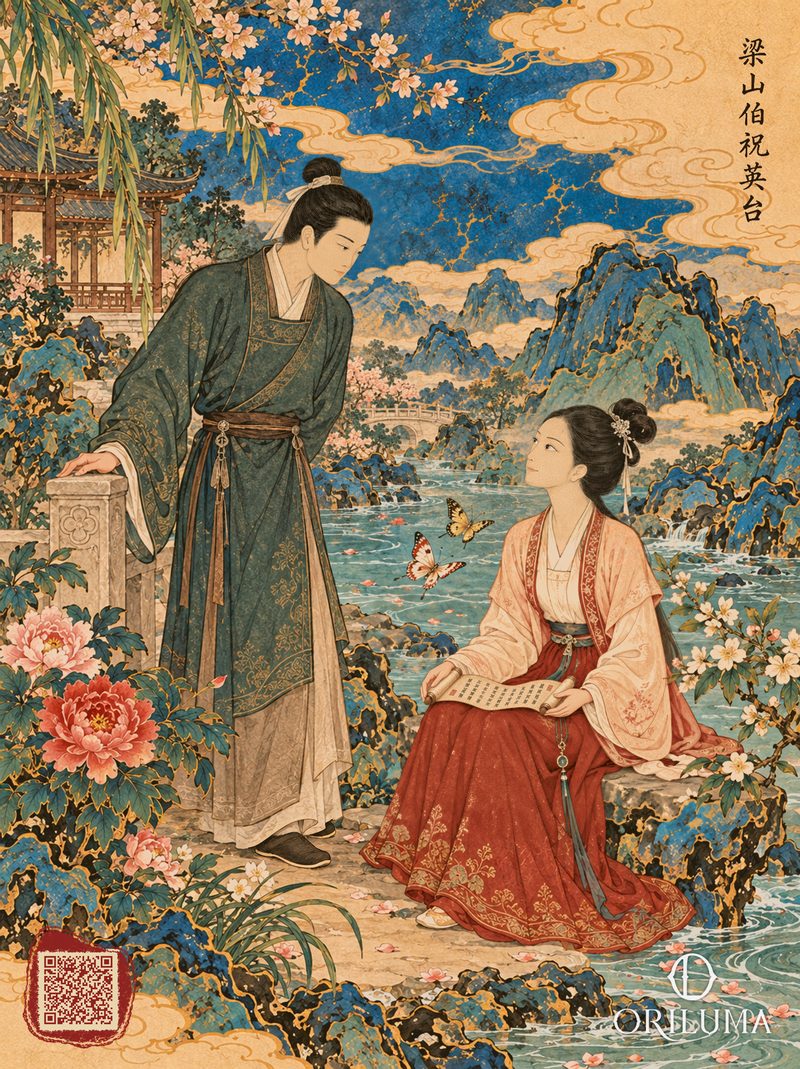
What the picture shows
Classmates who came to understand each other are parted by the rules of propriety; Liang Shanbo and Zhu Yingtai at last become butterflies, and a love that could not be fulfilled finds another kind of freedom.
On the left of the picture a scholar in a dark green robe stands by the water, one hand on a stone railing, looking down towards her. On the right a woman in an apricot jacket and a long red skirt sits on a rock in the water, a scroll open on her knees, looking up at him.
Between them two butterflies fly close together across the water. Behind them a clear stream stretches into the distance, with a small arched bridge upstream. Peonies are in full bloom at the lower left, willow branches hang at the upper left, the corner of a pavilion shows behind the willows, and a few petals float on the water.
They do not touch; there is only the meeting of their eyes. The scroll on her knees recalls the days they studied together; the butterflies tell the viewer in advance how the story ends, and give this tender picture a sadness that is hard to put into words.
It should be said that this scene does not come from the story itself. While they were classmates, Zhu Yingtai always presented herself as a man, and Liang Shanbo always took her for a sworn younger brother; by the time he understood the truth, she had been promised to someone else. Here she sits before him dressed as a woman and looks up at him, and he looks down at her in return: it is a meeting imagined by later people, letting the two see each other once as who they really were. The butterflies, for their part, only appear at the end of the story.
The story
The Butterfly Lovers
Zhu Yingtai longed to study. Disguised as a man, she left home and became Liang Shanbo’s classmate at an academy. Over years together she quietly fell in love with him and hinted many times, through metaphors, at who she was, but Liang Shanbo went on treating her as a sworn younger brother.
When they parted, Zhu Yingtai said she had a younger sister at home and hoped Liang Shanbo would marry her. When Liang Shanbo later learned the truth and went to the Zhu family, he found that Yingtai had already been promised to the Ma family, and the match could not be changed.
Liang Shanbo fell ill from grief and indignation and died. On her way to her wedding, Zhu Yingtai passed his tomb and insisted on leaving her sedan chair to make an offering. In the wind and rain the grave split open, she threw herself in, and then two butterflies flew out of the tomb.
In the picture the two face each other by the water, with butterflies already flying between them. This is a meeting imagined by later people; there is no such scene in the story. The painter has Zhu Yingtai sit before Liang Shanbo as a woman, their gazes answering each other, and this also reminds viewers that what truly kept them apart was not only a misunderstanding about identity, but a system in which people could not decide their own marriages.
History and context
Origins and culture
The legend of Liang and Zhu has been handed down for a very long time, and the early records differ from the full plot familiar today. Different places have attached the lovers’ home towns, the academy and the tomb to their own local landscape, producing many versions.
Adaptations such as the Yue opera “Liang Shanbo and Zhu Yingtai”, the violin concerto “The Butterfly Lovers” (Liang Zhu) and films have made the story one of the best-known Chinese love legends of modern times. Each art rewrites the transformation into butterflies in its own singing, melody or images.
Zhu Yingtai’s decision to study disguised as a man also takes the legend beyond a love story. Her pursuit of education and of a marriage of her own choosing both point to a woman’s wish not to be confined by the identity set for her.
The transformation into butterflies is both a consolation after tragedy and an accusation: only by leaving the rules of the human world do the two become free. The work keeps the butterflies light, but does not let the viewer forget the price paid for that lightness.
An early textual clue to the legend is a passage in the Southern Song Qiandao Siming Tujing (Illustrated Gazetteer of Siming, Qiandao Era) quoting the Shidao Sifan Zhi (Record of the Ten Circuits and Four Borderlands) by Liang Zaiyan of the early Tang: “The righteous woman Zhu Yingtai shares a grave with Liang Shanbo.” The Shidao Sifan Zhi itself is lost, and this secondhand quotation cannot directly prove what the Tang original actually looked like. An early text with a fuller plot appears in the Tongsu Bian (Compendium of Popular Usage) by the Qing scholar Zhai Hao. He says it comes from the Xuanshi Zhi by Zhang Du of the late Tang, but the passage cannot be found in the Xuanshi Zhi as it survives today, and scholars have questioned this attribution. The text says that Zhu Yingtai was a daughter of the Zhu family of Shangyu who studied disguised as a man and came to know Liang Shanbo; Liang Shanbo later died and was buried at Maocheng (around present-day Ningbo). Zhu Yingtai passed by on her way to her wedding, wind and waves kept her from going on, she wept at the grave, the grave split open, and she leapt inside. This version already holds the outline of the later plot.
The legend of Liang and Zhu is told in Ningbo, Hangzhou, Yixing, Jining, Runan and other places, each with its own sites and tombs. In 2006 the “Legend of Liang and Zhu” was included in the first list of China’s national-level intangible cultural heritage.
In 1959 the violin concerto “The Butterfly Lovers”, composed by He Zhanhao and Chen Gang, was first performed in Shanghai. Telling a Chinese story with Western instruments, it carried the legend into concert halls around the world.
Further reading
Sources and references
- Shidao Sifan Zhi (Record of the Ten Circuits and Four Borderlands)Liang Zaiyan · early Tang; quoted in the Southern Song Qiandao Siming Tujing
- Tongsu Bian (Compendium of Popular Usage)Zhai Hao · Qing dynasty
- “Liang Shanbo and Zhu Yingtai” (Yue opera)
- “The Butterfly Lovers” (Liang Zhu), violin concertoHe Zhanhao and Chen Gang, 1959
More in this set