
Mural Collection · Myths & Legends
The Flower-Scattering Celestial Maiden
Sǎn Huā Xiānnǚ · The Flower-Scattering Celestial Maiden
Basis · Inspired by tradition
Theme · Immortal Tales
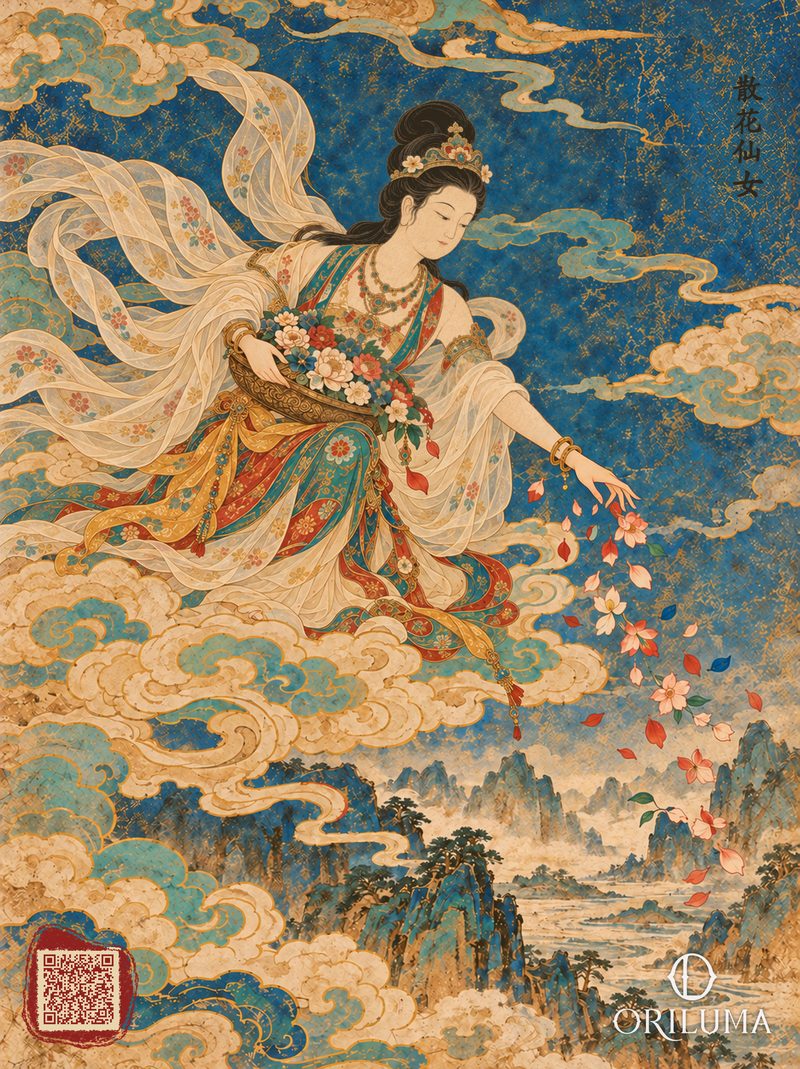
What the picture shows
A celestial maiden scatters heavenly blossoms; through a graceful shower of flowers she puts attachment to the test, and wisdom becomes a rain of flowers filling the sky.
The celestial maiden sits on a cloud with a bowl full of fresh flowers in her arms; one hand reaches out, fingertips pointing down, and petals drift down with her movement. She wears a crown of flowers, and her silk shawl winds around her arms and curls all the way up to the top of the picture.
The sky is deep blue, with clouds of gold and jade green; below are blue-green mountains and a winding river. Petals in red, pink, white and blue stand out vividly against the deep blue, like a rain of flowers falling only on the human world.
This picture is very still: the figure is seated, the flowers slip from her hand, and there is no sense of flight. The painter cares more about the moment of scattering. Her expression is unhurried, even touched with a calm smile.
The story
The Flower-Scattering Celestial Maiden
In the Vimalakirti Sutra, a heavenly maiden listens to the Dharma in Vimalakirti’s room. Seeing how finely the assembly expounds the teaching, she scatters heavenly flowers over the bodhisattvas and disciples, and uses whether the flowers cling to them to test whether their minds still hold discrimination and attachment.
The flowers that land on the bodhisattvas slide off of themselves, but those that land on some of the disciples stick and will not leave. The disciples hurry to brush them off; the heavenly maiden points out that the flowers themselves make no distinctions, and that it is the discriminating mind that turns them into a hindrance.
In this exchange the heavenly maiden is no silent ornament. When Shariputra asks her why she does not change her female body into a male one, she asks in return where the “marks of a woman” are actually to be found, and then uses her supernatural powers to make the two of them swap appearances, showing that awakening is not decided by outward form and cannot be confined by fixed ideas such as male and female.
The picture turns this teaching into a rain of flowers: the bowl tilts, the sashes stream in the wind, and small petals scatter with the figure’s movement. The viewer is first drawn in by this lightness, then recalls the story in the sutra: flowers that fall on someone whose mind holds no attachment slide off by themselves, while on someone still attached they stick and will not leave.
History and context
Origins and culture
As the sutras spread, the flower-scattering story entered the murals of Dunhuang, temple sculpture and scroll painting. Images of flying apsaras (feitian), heavenly maidens and donors sometimes influenced one another, so that “The Flower-Scattering Celestial Maiden” took on many artistic forms.
Chinese art often uses long streaming ribbons to show celestial figures in flight. The figures need not actually have wings; sashes, clouds and the slant of the body are enough to give a still image a sense of rising.
The subject later entered the theatre. In 1917 Mei Lanfang created the Peking opera Tiannü Sanhua (The Heavenly Maiden Scatters Flowers): the heavenly maiden is sent to scatter flowers, admires the sea of clouds along the way, and finally opens her flower basket where the Dharma is being taught. For it Mei Lanfang designed a long silk ribbon dance, in which a single ribbon becomes clouds, flight and swirling on the stage. The play is one of the signature works of the Mei school and gives equal weight to singing, speech and dance; it does not depend on complicated conflict, but shows the body language of Peking opera through the figure’s movement in space, the paths of the ribbon and the image of the rain of flowers.
The long silk lets a wingless figure seem to fly, but it also demands precise control of force from the performer: too slack and the ribbon will not take shape, too hurried and it loses its roundness. The lightness comes from intensive training. Stage adaptations also change the figure’s identity and the plot, but the rain of flowers, wisdom and the breaking of attachment always remain at the core.
So the celestial maiden scattering flowers is not simply a scene of blessing. She turns beauty into a teaching that is gentle and yet sharp: what truly needs brushing off is not the flowers on one’s robes, but the distinctions in one’s heart that one will not let go.
The Vimalakirti Sutra is a classic whose strength lies in dialogue. Its central figure, Vimalakirti, is a lay Buddhist, yet with his wisdom he wins over many disciples. The episode of the heavenly maiden scattering flowers turns the abstract idea of “non-discrimination” into visible flowers: on whom they fall, and whether they stick, becomes a gentle test.
The meaning of “scattering flowers” in the opera can also be read in two ways: as an offering and blessing to those teaching the Dharma, or as the “test” of spiritual practice in the sutra. Both readings have a basis in the plot of the Vimalakirti Sutra.
Readers also differ on the exchange between the heavenly maiden and the disciple in the sutra: some read it as a teaching that breaks down distinctions of gender, while others point out that it comes from an ancient Buddhist text and should be understood in the context of its time, rather than mapped directly onto today’s ideas.
Further reading
Sources and references
- Vimalakirti Sutra (Weimojie Suoshuo Jing), chapter “Contemplating Sentient Beings”translated by Kumarajiva · Later Qin
- Peking opera Tiannü Sanhua (The Heavenly Maiden Scatters Flowers)Mei Lanfang, 1917
More in this set