Mural Collection · Myths & Legends
Nüwa Mends the Sky
Nǚwā Bǔ Tiān · Nüwa Mends the Sky
Basis · Directly based on source material
Theme · Chinese Myths
What the picture shows
When the sky split and the earth tilted, Nüwa smelted stones of five colours to mend the sky, and with a creator’s strength set the world at rest again.
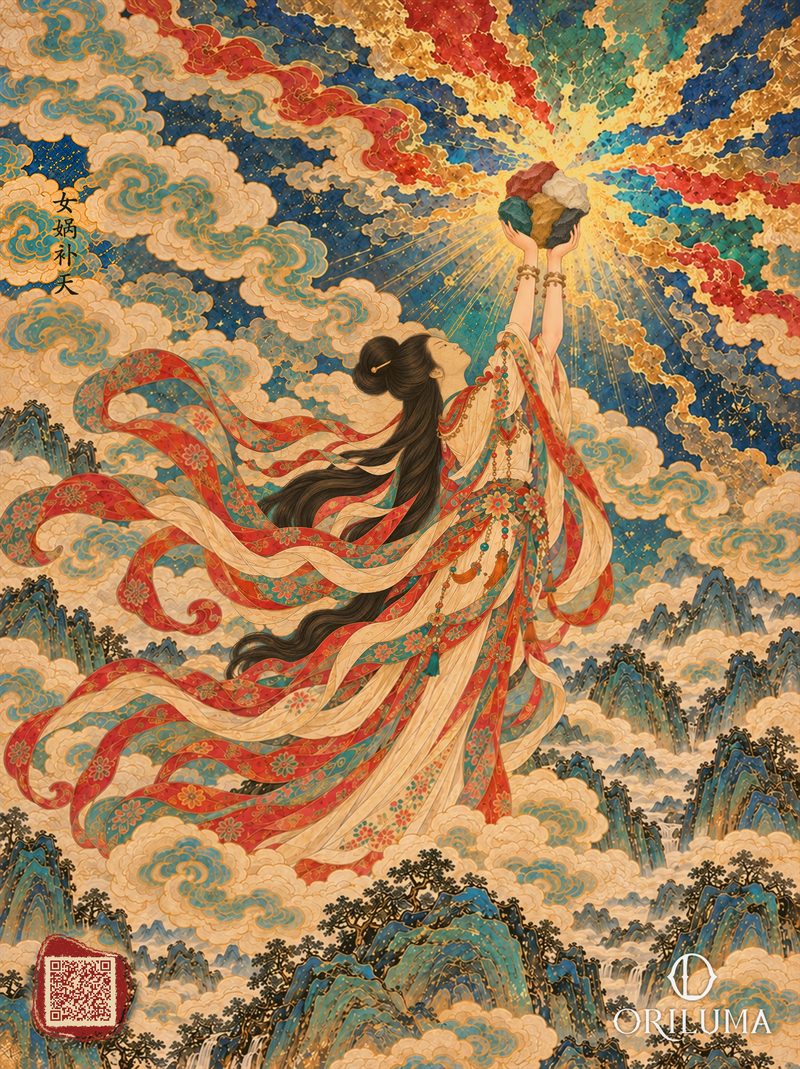
Nüwa seems almost borne up by light: she rises upwards, both arms raised, holding a mass of five-coloured stones. Red, yellow, blue and green rays radiate from the stones in every direction, like a flower bursting open.
The blue of the sky is cut by the rays into separate pieces, a sea of clouds churns beneath her feet, and below lie ranges of blue-green mountains, layer upon layer. Her long hair and red silk ribbons stream downwards and backwards, forming with her raised arms two lines that run in opposite directions.
The painter has shown “mending the sky” as a task done by hand: not magic worked with a wave, but two hands lifting the stones high, so that the viewer sees the effort in her pose.
The story
Nüwa Mends the Sky
Ancient myth tells that a great catastrophe struck heaven and earth: the pillars of the sky broke, cracks opened in the heavens, the earth tilted, fire and flood spread together, and wild beasts threatened people who had nowhere to shelter.
Seeing all living things suffer, Nüwa gathered stones of five colours and smelted them, and with the molten stone she patched the sky. She also cut off the legs of a giant turtle to serve as pillars at the four quarters, so that heaven and earth, on the point of collapse, stood firm again.
The myth also says she quelled the flood, rid the land of wild beasts and blocked the overflowing waters with the ashes of reeds. When the mending was done, sky and earth returned to order, yet traces remained, offered as explanations of the land’s shape, such as the northwest being high and the southeast low.
In the picture Nüwa holds the five-coloured stones high, her sashes flying in the clouds. The light of the stones lets people see hope in the midst of disaster, and her upward-lifting pose makes “mending the sky” a hard and very real labour.
History and context
Origins and culture
A fairly complete account of Nüwa mending the sky is found in texts such as the “Lanming” chapter of the Huainanzi, and different ancient books do not entirely agree on the cause of the catastrophe or the details of what she did. Later, stories such as Gonggong striking the mountain became intertwined with the myth of mending the sky.
In Chinese myth and legend Nüwa did not only mend the sky; she also made human beings, created the sheng reed pipe and instituted marriage, and she is revered as an ancestor of civilisation. She both created life and protected it when the world broke apart, and in her “creating” and “mending” become one and the same responsibility.
In later literature the five-coloured stones kept gaining new meanings; Dream of the Red Chamber opens with a stubborn stone left over, unused, from the mending of the sky. The ancient myth thus not only explains heaven and earth but also became a resource for writers reflecting on talent and its use, on loss and imperfection, and on fate.
Looking at Nüwa mending the sky today, one can still feel the story’s respect for those who repair. A hero does not build order only by conquest; she can also bend down to gather the fragments and, after disaster, join the shared world together again.
The “Tang Wen” chapter of the Liezi also says that Nüwa “smelted stones of five colours to mend its gaps, and cut off the legs of the giant turtle to set up the four pillars”, broadly in agreement with the Huainanzi. The Liezi then goes on to tell how Gonggong struck Mount Buzhou, and how the sky tilted to the northwest and the earth sank in the southeast. These episodes from different texts later merged by degrees into a fuller story of Nüwa mending the sky.
The story of Nüwa making human beings appears in the Fengsu Tongyi by Ying Shao of the Eastern Han: when heaven and earth were first separated there were no people, so Nüwa shaped figures from yellow earth; later, unable to keep up, she swung a cord through the mud, and the drops of mud that flew off also became people. This account writes “creation” and “labour” together.
In Han dynasty stone reliefs and in Tang dynasty paintings on silk excavated at Astana in Turpan, Xinjiang, Fuxi and Nüwa both appear with human heads and serpent bodies, their tails intertwined, one holding a compass and the other a set square. Nüwa was regarded as an ancestor of civilisation, not merely a goddess who saved the world from disaster.
Further reading
Sources and references
- Huainanzi, “Lanming Xun” (Surveying Obscurities)Western Han
- Liezi, “Tang Wen” (The Questions of Tang)pre-Qin to Wei–Jin
- Fengsu Tongyi (Comprehensive Meaning of Customs)Ying Shao · Eastern Han
More in this set