
Mural Collection · Myths & Legends
The Mermaid
Yú Měirén · The Mermaid
Basis · Inspired by tradition
Theme · Immortal Tales
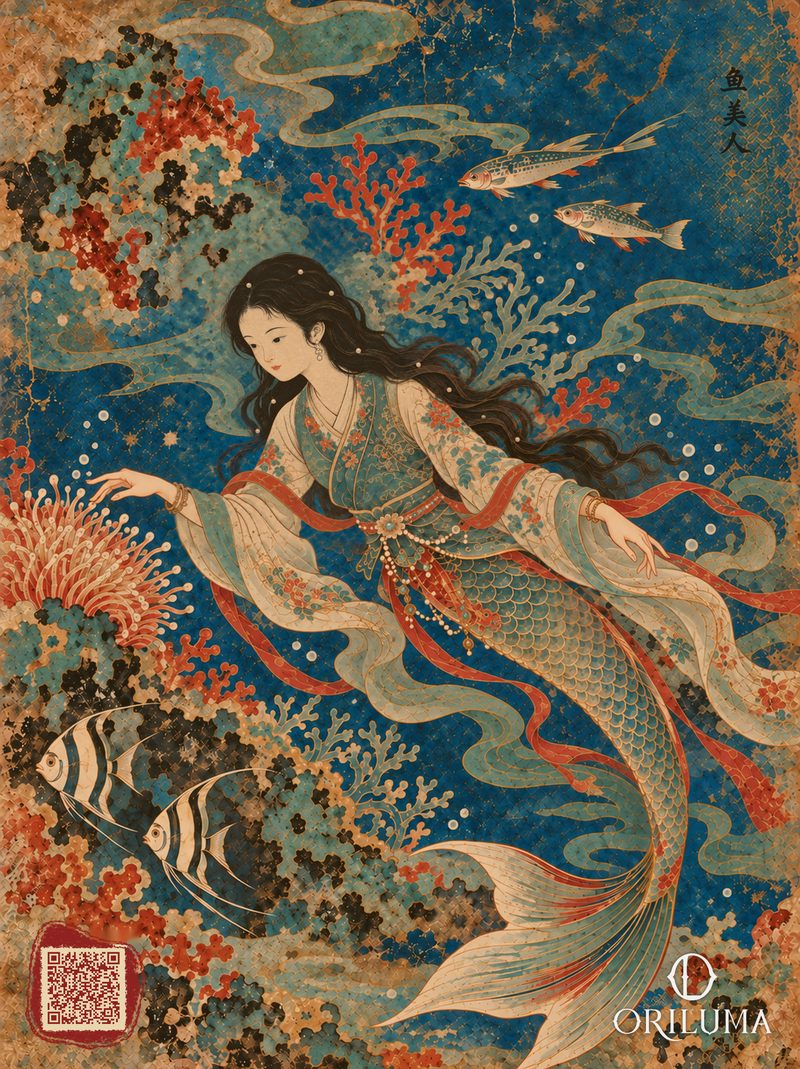
What the picture shows
A mermaid from beneath the water comes into the human world, linking two different worlds through love, courage and dance.
The mermaid in the picture is human above the waist; below it is a fish tail covered in blue-green scales, its fin spread out like a sheet of thin gauze. She swims sideways towards the left, one hand reaching forward, her fingertips almost touching a red sea anemone.
Her long black hair spreads out in the water, dotted with pearls, and she wears strings of beads at her neck; red, blue-green and white ribbons float upwards like light rising through water. Around her is deep blue sea, with small silver fish and black-and-white striped fish, and bubbles rising in strings.
In the lower left corner is a reef covered in coral, black mixed with red. She is not swimming towards the surface; she looks down towards the anemone at the lower left, calm, as if searching for something.
The story
The Mermaid
On the modern stage, “the mermaid” has more than one story. The best-known version, a dance drama, tells of a mermaid from the sea floor who falls in love with a hard-working, brave hunter. The two meet across the barrier between water and land, but a mountain demon sets out to ruin them.
The mountain demon works its magic: the hunter is sunk into the sea, and the mermaid is carried off. Neither will give in. The mermaid resists together with the hunter and her companions of the water; the Old Ginseng Man lends a hand, helps them see through the demon’s spells, and in the end they defeat the mountain demon.
The dance drama turns the transformations, separations and reunions of traditional myth into rippling water, ensemble dances and confrontations suited to dance.
The mermaid in the picture has a human upper body and a fish tail, and is swimming into the depths. Soft curves suggest the flow of water, and the arm reaching forward shows that she is not a still curiosity but someone actively choosing her fate.
History and context
Origins and culture
The dance drama The Mermaid (Yu Meiren), first performed in 1959, had the Soviet expert Gusev as chief choreographer and director. It drew on Chinese folk dance and the movement of traditional opera, while borrowing the structure and technique of ballet, and is one of the important works in Chinese dance drama’s search for a national form of expression.
In folk opera there is also Zhui Yu (Chasing the Fish), in which a carp spirit takes the form of Jin Mudan and falls in love with the scholar Zhang Zhen; films and television series based on it are also often titled Yu Meiren. Its plot is not the same as the dance drama’s, but the two share the motif of “a woman of the water coming into the human world”.
In traditional imagery, fish stand for abundance, freedom and the continuation of life, and water is often used to express change and feeling. So the mermaid figure carries the warmth of a love story while keeping the mysterious, flowing quality of the world beneath the water.
This work need not be tied to any one stage design. It can be seen as a meeting point of several “mermaid” traditions: a figure emerges from the water and shows, through her own actions, that understanding and companionship are still possible between different worlds.
The image of a “fish person” appeared early in China. The Bowuzhi (Records of Diverse Matters) by Zhang Hua (232–300) of the Western Jin records “jiaoren” in the South Sea who dwell in the water and live like fish, yet keep weaving cloth without pause, and whose tears can turn into pearls. Later, “the jiaoren weeping pearls” became an image used again and again in poetry. The jiaoren are not necessarily the mermaid in this painting; they are mentioned here only as cultural background. The West too has ancient mermaid legends: seals from Mesopotamia bore figures with a human body and a fish tail very early; in the 1st century BC the ancient Greek historian Diodorus recorded that the goddess Derceto, near Ashkelon (on the coast of present-day Israel), had a woman’s face and a fish’s body. The Sirens of Homer’s epics, who lure men with their song, were at first half woman and half bird, and only in the early Middle Ages came to be described with fish tails. The best-known mermaid story in the West is Andersen’s “The Little Mermaid”, published in 1837. The mermaids of East and West each followed their own path.
Further reading
Sources and references
- Bowuzhi (Records of Diverse Matters)Zhang Hua · Western Jin
- The Mermaid (Yu Meiren), dance drama1959
- “The Little Mermaid”Andersen · 1837
More in this set